When you and I in the West were taught history, we were taught that all the important stuff started with the Greeks. Before that we learned about the Fertile Crescent and how urbanization and agriculture started there. Maybe we learned something about ancient Egypt and that some other civilizations existed, but they were foreign and curious and separate. We got a few things from them, like silk and gun powder from China, but these were just one-offs. Then our civilization really came together with Rome and the rest was ‘history’. The action was always centered around the Mediterranean. That’s the center of the world for us. And if you’re English or Northern European or English speaking then maybe the center is more like London, Paris, Rome- a central axis maybe.
That’s cool, if you’re English speaking then that was probably the only geography that concerned you for a bunch of recent history. That’s not a false historical perspective on its own, but it is, unfortunately, a very limited perspective.
Let’s try walking backwards for a little bit. First, if you are an American then there is a very good chance that your very own ancestors aren’t all from England, so you are first of all accepting somebody else’s historical perspective as your own. And by the way, the same story applies to almost anybody reading this blog- the version of history you are always reading is a version written by somebody else and for their own purposes, to tell their own side of the story. It doesn’t mean it’s wrong, it’s just that it was written from a certain perspective, and that perspective has its limitations. When you read this version of history, you are taking the perspective of the Church and the royals who wrote history as the sole version of history that mattered. You are reading that your ancestors were barbarian Celts, Franks, Anglo-Saxon Germans, Russians, and what not, and then civilization arrived from Rome.
For a little perspective, do you know that you are probably only between 5 and 10% Germanic even if you are pure English? You are mostly ‘Celtic’. What’s a ‘Celt’? Turns out, the ancient Celts are basically a mixture of people who migrated up from the Middle East who migrated to Europe after the last ice age 10,000 years ago, and Central Asian barbarian Scythians (more or less), and they only arrived in the British Isles and Western Europe around 5800 years ago from the Steppes. The story of the rest of Europeans is almost identical.
And just to make you think a little bit more about how even the story of you own history is surprising and not what you thought, did you know that Europeans were basically black until 5800 years ago? White skin genetics arrived with Middle Easterners and Central Asians- your ancestors. (https://www.dailymail.co.uk/sciencetech/article-3028813/Europeans-dark-skinned-8-000-years-ago-Pale-complexions-brought-Europe-Near-East-study-claims.html)
The historical perspective we learned was inherited from the Romans and their Catholic church, who brought their own Mediterranean-centric perspective with them. Okay, but where did Rome’s culture come from? First, we know they got a lot of stuff from the Greeks- fair enough- and a lot of that came via their territories in Alexandria, Egypt. So, already, we are on the main Silk Road trade routes. Plato and other classical Greeks stated that they learned everything from the Egyptians (https://africanholocaust.net/greece-studied-kemet/) The Greeks, although great innovators, learned am immense deal from the Egyptians (see Black Athena by Martin Bernal for an in-depth discussion of this), but they also seem to have been talking to peoples from further east. Alexander the Great made it all the way to India and set up a direct communications channel to the very heart of Central Asia, in today’s Northern Afghanistan and Pakistan. The Greeks were constantly interacting with the Persians, who controlled things all the way to the borders of China. They were interacting with the Turks and Mongols who connected them to things in Siberia. So we know that once we get to the Mediterranean we are already plugging in to a vast network of cultural exchange, so this is where the West plugged in to this system. This is merely to say that Europe was connected to the ancient Silk Road trade network, consciously or not. Many historical influences came through this connection, up to early modern times. In ways you could say that the silk road was the cause of modern times.
It is often said that Genghis Khan gave birth to the modern era. When his Mongol hordes broke down the barriers between civilizations he also connected China and the West directly, under the flag of a single empire. (see ‘Genghis Khan and the Making of the Modern World’, by Jack Weathorford). The Mongol empire built up a European taste for Chinese goods (https://www.economist.com/books-and-arts/2007/12/19/genghis-the-globaliser) that led to European exploration and colonization in an effort to cut out the middlemen in this valuable trade. Columbus ‘discovered’ America in a quest to find a different route to India.
However, this trade route had always existed but it was full of intermediaries, which obscured the extent and connectedness of the trade system. In classical times the trade had been more direct between Rome and Central Asia’s Kushans. The Romans complained about losing all of their gold to India due to trade. After the rise of Islam there was an intermediate empire interjected between East and West and this trade was greatly reduced.
How can we think of this trade network in a more accurate manner? First, we call it the Silk Road but that is just a name given to it in more recent times. It was not just about silk, it was a system of trade routes, only one of the traded items being silk.
First, let’s look at a map of the main Eurasian Silk Road routes. Note that central Asia, above Persia, is at the center of the map. It is also the midpoint between most of the civilizations on that map.
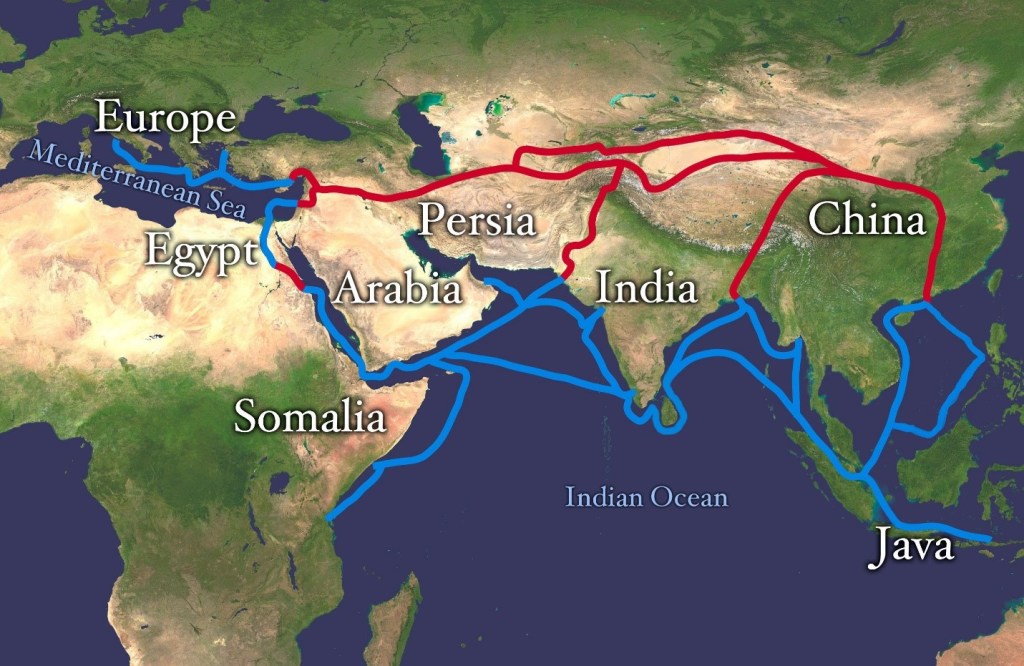
Wikipedia map
Then lets add the Saharan trade routes
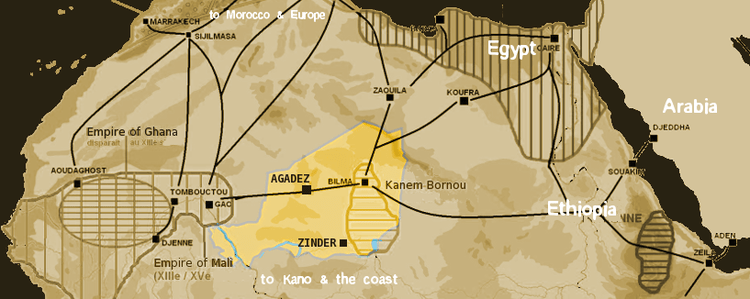
Wikipedia map
Here are the Roman trade routes:
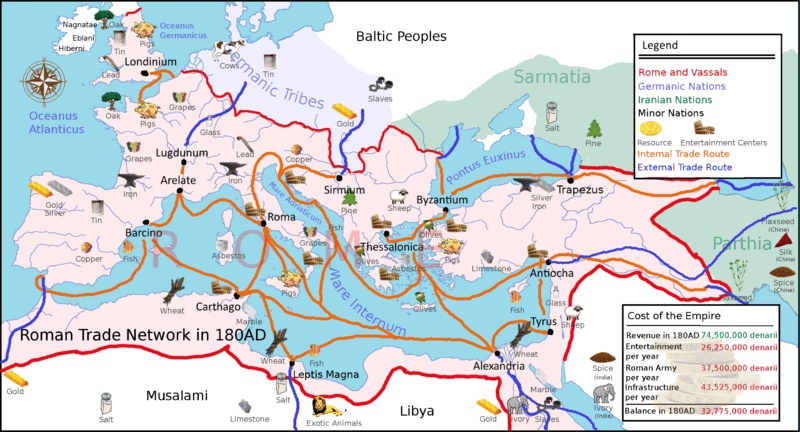
Wikimedia Commons image
So what we have here is a network that connected most of the peoples of the Old World. There is also some evidence for occasional connections to the Americas, but that is a more complicated subject. However, the Americas don’t seem to have been completely disconnected either.
Although this is a vast network, there was also a main central point of this network, historically, and that was the region of Northern Afghanistan, Eastern Iran, Uzbekistan, and Central Asia in general. This was the main connection point between hugely different empires, and it was the site of a great deal of cultural exchange as a result.
We also tend to think of Central Asia as a vast no-man’s land that could have been a place where people crossed paths in olden times but it was probably nothing on its own. Nothing could be further from the truth, actually. This region was an incredibly prosperous, sophisticated, cosmopolitan, intellectual and spiritual world. Hwever, not much remains today in terms of ancient buildings you could visit as a tourist for a couple of reasons: first, the buildings themselves were mostly built of mud bricks and mud bricks do’t survive for a long time without constant repair, so they are mostly gone. Second, this region has been passed over by many waves of invaders who destroyed the things that were there from the past, and they did it on purpose and did it thoroughly. Third, there has been some degree of climate change in the area so that it is more like a desert than it used to be. And fourth, we haven’t really looked that much because it was so out of the way from our modern world’s interests for so long, and there have been political and safety challenges in the region for some time so it was hard to do any aracheological digging in this region. However, modern Russian, Chinese, and now local archaeologists have started looking, so we will have more to look at as time goes on.
What we have learned though is that central Asia was itself an incredibly vibrant cultural center all of its own. Many of the innovations we think of as critical to the modern world came from there. Modern experimental science, astronomy, modern medicine, modern mathematics such as algebra all come from central Asians. Rumi was from there. We have heard that these things came from the Islamic world, but actually they came from central Asians who were writing in Arabic and got famous through their connections to the Arab capitals such as Baghdad where they went to work later in their lives. Rumi was from Afghanistan but moved to Turkey, which is where you know of him from.
For more on this check out ‘Warriors of the Cloisters: The central Asian origins of science in the medieval world’ by Christopher I. Beckwith.
Here is an example of the sophistication of this cultural world from one of the murals of Penjikent (this is an artist’s reconstruction but it makes it clearer this way).
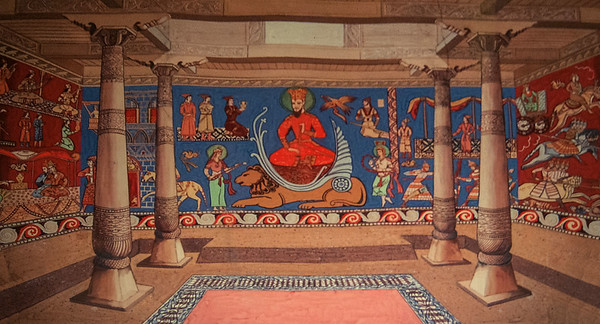
Think of the Silk Road as a network of cultures, like nodes in a web of peoples. Central Asia was the common meeting room and heart of the network. We in Europe and elsewhere were part of this system. However, we were in a more remote part of the network, not in the center of much of the historical action. In modern times Europe became a center of attention, then America, and maybe now China will rise to the fore. Still, it is the same network and at different times different parts shine. The network itself remains unchanged.
For a more accurate vision of history switch your attention to the human network, and make the center of your vision Central Asia. In this network we are all one extended family. All of the different peoples in it are cousins. Central Asia was our main common area and our most important marketplace.
 Shambhala Caravanserai