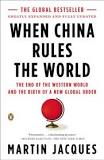
The ancient Silk Road was the shape of trade of much of the world for much of history, but it hasn’t been in recent centuries. Colonialism changed that. Starting in the 1400s Europeans started looking for ways to get around the Silk Road middlemen (mostly the Islamic world) who had been bringing them goods they had recently fallen in love with- spices and silk primarily- primarily because of the trade opened up by Chinggis Khan. Out of these journeys of European exploration grew the world we know today, with European powers (aka the West) gaining control over the world, and more recently the USA. The USA has led with an approach to running the world which has been called ‘monopolar’- a single power in control of the world. This has been for a blip in time as far as history is concerned, but it is the world that we all know.
What’s happening now is that the West seems to be losing relative power and the rest of the world is gaining power, leading us to what is starting to be called a ‘multipolar world’- a number of different powers asserting control in their own regions- and in theory a new kind of global stable power system will be developed. This is particularly being led by China, with the help of Russia. But we all know that it is mostly China. China has been laying the groundwork for this new China led system for at least a decade now in a few ways. It has developed, along with Russia, an entire replacement international financial system to replace such Western-led things as the World Bank. It has also been building a massive new trade system that it calls the Belt and Road initiative (BRI), or the New Silk Road. This network or train rails, roads, and sea routes is basically a reestablishment of the ancient Silk Road system, of which China was a fundamental part in the old days. There is even a plan afoot to include the USA in the overland route- making the US (and by extension the rest of the Americas) truly a Silk Road country (http://www.interbering.com/)
This new system has some characteristics which are fundamentally different than the Western-led system of recent centuries. First, it does not have one power directly running the whole show and imposing its values directly onto the various other peoples, but is instead a network of powers each responsible for managing its own region, with each region function according to its own local cultural rules and preferences, and with none imposing its style on others. These could maybe be thought of as cultural zones. China envisions this as a more cooperative arrangement, and as ‘globalization with Chinese characteristics’, or ‘chiglobalization’. The Russians have spelled out a very similar vision. (http://www.4pt.su/en/regions/multipolarity))
An interesting feature of this new global order vision is that it looks a lot like the older order, the first global order, the Silk Road system. In fact, China views it very much that way, as an updating of their old Silk Road world order “If one reads through enough state media or official speeches on Belt and Road, it becomes apparent that a stylized history of the original Silk Road plays an important role for BRI. By constantly hearkening back to the history of East-West exchange, Chinese outlets seem to be interested in propagating a narrative of a particular kind of globalization in which China had a central and ostensibly benign role. In this old “Silk Road Spirit,” which Xi Jinping seeks to make anew, value-indifferent trade—not politics—drove interconnectedness and the advance of civilization.” (https://thediplomat.com/2017/10/the-belt-and-road-initiative-and-the-future-of-globalization/)
So China has a vision of returning the world to a renewed version of the very old global trade system. I’m not sure many people in the West or in the USA in particular are quite prepared for this shift in perspective because we have little to no experience of this kind of a world. We also have little understanding of some of the values that go with this world. But just like the leader of any organization creates a tone for the entire organization operating under him, the coming era of Chinese leadership is going to bring back some ways of thinking that people in the West are likely to find a little disorienting- a growth of so-called Eastern religions, for example. It’s one thing when people find a religion of some poor and unpowerful country interesting, but something else when it’s the religion of the most important and powerful countries in the world. It’s going to become a lot more attractive and prestigious. India is expected to be the fastest growing economy in coming decades as well- so Buddhism, Taoism, and Hinduism will be seen as the spiritualities of the most successful and fastest growing countries in the world. It will be a lot harder to consider them marginal and backward religions when that happens. This is similar to how, in recent centuries, Christianity has been considered something of a prestige religion due to its association with the world’s superpowers
Their value systems will also become prestigious and attractive to learn from. Their philosophies will be studied and taken seriously. Along with this will inevitably come the logic that western thought is old-fashioned and outdated to some extent. It’s just how people’s brains work.
This is similar to the more recently famous competition of business models in America between the older style management system of industrial businesses where it is all a top-down command structure, vs the more modern style of Silicon Valley leadership, a famously non-top down style of leadership (https://smallbusiness.chron.com/hierarchical-leadership-vs-nonhierarchical-leadership-35422.html). Of course, China itself is famously authoritarian, so the new vision is some combination of both approaches. Each player in this multipolar world is free to have its own way of doing things and its own value system but the network itself is non-hierarchical and far more egalitarian than in a monopolar system.
Of course, another possibility is that this multipolar world is only an intermediate step on the way to China being the new monopolar world leader. China is already, in 2019, the world’s largest economy in terms of purchasing power, and is likely to surpass the US in GDP by 2030. China does not have the military power that the US has but it certainly has plenty of strength in its partnership with Russia already, and will develop a far stronger military soon enough. How will we think about ourselves when China is the lead power in the world? Well, it will be different for sure.
Europe is also wrestling with this question, but the situation is likely to be different for them than for the USA. Europe was traditionally a part of this trading system and is physically inseparable from it. It is likely to flow semi-seamlessly into the new-order. It also has always had to workl cooperatively with other countries since it has never had an ocean between itself and others. It has also not been the monopolar power so it won’t have to give that up. (https://blog.press.princeton.edu/2018/06/15/how-the-big-pieces-fit-together-europes-place-in-the-multipolar-world/)
Another parallel change happening to the US is the rise of multiculturalism and a far more diverse population as a reality. The US is projected to become ‘minority white’ by 2045. (https://www.brookings.edu/blog/the-avenue/2018/03/14/the-us-will-become-minority-white-in-2045-census-projects/). California was already there in 2015, with only 38.4% of the population being white non-Hispanic. If you are attached to another vision of the country then that is apparently something of a challenge to get used to, if current politics are any indicator. So in some way the rise of multipolarity is occurring in our own country. If you are attached to a vision of one single culture being the only true way to be an American or European of whatever sort then you are probably having a hard time dealing with these changes. However, minorities of all sorts have always had to deal with this and have learned how toggle between worldviews, languages, and value systems without any issue, so this is plenty manageable. I am an Irish American who lives in an almost completely African-American neighborhood in Los Angeles, a city where the white non-Hispanic population was already only 28.7% by 2010 and I am having no problem at all, so this is doable. In the future of this country we will all belong to an ethnic minority and eventually we will intermarry and come up with something new, combining all of our cultures into something new. We’ll get used to it and make it work. It’s going to be alright- we’ve already done it here in California and it’s going to work wherever you are. And you’ll probably like it, actually.
Get used to this multipolarity concept, You’re going to need to do it, and its not going away.
 Shambhala Caravanserai