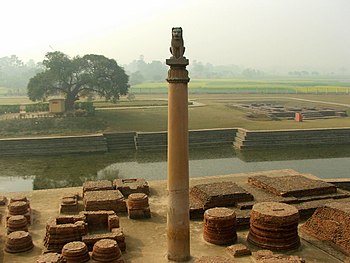
Buddhist political thought is very closely related to the idea of Shambhala. With roots in the writings of Ashoka and Nagarjuna, it had influences throughout central Asia and East Asia until very recent times; and even today Nagarjuna’s writings are being explored today by the followers of Engaged Buddhism. The first source of Buddhist political thinking we have can be found in the edicts of Ashoka, an ancient Buddhist King. These are short prescriptions with a powerful vision. However, the most important source of Buddhist- and in particular Mahayana Buddhist- political thought is in the Ratnavali (‘Advice to a King’), by Nagarjuna, as well as his Letter To a Friend. Nagarjuna was a great Buddhist thinker from the second century CE and was likely from Southern India. However, the center of a great deal of Mahayana Buddhist activity in that era, and in the centuries after his time, was central Asia. In areas such as today’s Afghanistan, Pakistan, Tajikistan, and the deserts of China’s western regions, large Buddhist kingdoms thrived until the 1100s. The rulers of these kingdoms were greatly guided by Buddhist political thought until their collapse, and there was an important sutra, the Golden Light Sutra, unique to East Asian Buddhism, that held influence in Japan and in China until very recent times. The country of Tibet was run according to these texts and principles until the 1950s.
Subsequent Buddhist political manuals have arisen through time, particularly in Tibet, to help guide rulers. In the English speaking world we now have, in addition to a number of translations and commentaries on the Ratnavali, the excellent text “The Just King” by Jamgon Mipham. This book is highly recommended for anyone interested in Engaged Buddhism or in Buddhist political ideas. In this excellent text Mipham, who was actually a royal advisor in the 1800s, gathers a number of other politically oriented texts and makes his own brilliant commentaries which very much help to unpack the Buddhist political and social vision.
Shambhala is an example of a Buddhist pureland. These are something like a heaven realm meets a utopia- realms of perfect harmony and bliss. Although lamas teach that ultimately these are symbols of a pure heart, they are at the same time models for perfect kingdoms filled with Bodhisattvas, beings devoted to compassion, wisdom, and actively helping others. In the system of paramitas, or perfections, taught within Mahayana Buddhism there is a logic of what a perfected person is like, but with implications for a perfected society made up of such persons. This would be a pureland such as Shambhala. Like Shambhala, which is ruled by a perfect wisdom king. An earthly ruler who wishes to model his kingdom after such a perfect mythical kingdom would need to follow principles of the same sort as does the king of Shambhala. Nagarjuna, as the philosopher who spells out the principles of such a king as taught by the Mahayana tradition, would be the one to turn to for the foundation for the political teachings of Shambhala.
What kind of leadership does Nagarjuna recommend? His ideal leader is an interesting combination that evades current right-left poles. In many ways he could be seen as a social-democrat advocating for the king’s responsibility to oversee the well-being of his subjects by insuring access to education and public health resources, providing for the poor, and reducing conflict. At the same time he also takes a libertarian approach and encourages prosperity and ensuring healthy and thriving trade all while promoting freedom, non-violence against others, and independance of thought. Yet he also urges social conservative views such as considering that the purpose of the government is to promote virtue, uphold traditions, and to punish wrongdoers (with merciful and just punishments, but certainly not pacifism). He also promotes a cosmopolitan vision of by urging the peaceful coexistence of numerous faith traditions within his kingdom without favor, telling the king to support the various traditions and to not enforce any one religion but rather to support each religion in producing the best followers and the best ethical behaviors according to their own tradition. He encourages every individual, especially the king himself, to develop the highest level of virtuous behavior and wisdom, urging the king himself to be a role model and to set a tone for others in his kingdom.
Individuals in the Buddhist tradition in general are taught to take responsibility for themselves and their own condition, yet at the same time individuals are taught to be of service and to help others. The society has responsibility to help others to have the resources to help themselves. The Buddhist ethical view followed by Nagarjuna does not prescribe specific behaviors to be followed and promoted by a ruler so much as it recommends general areas of importance in conduct and self-development. These are general traits to be developed by both an individual and a society such as generosity, patience, wisdom, moderation, and non-attachment. In addition the ruler is urged to provide basic education and health care; a decent minimum standard of living; basic security and justice; and the provision of public goods that enable the thriving of the society (such as bridges and roads and a healthy water supply.)
There are extremely similar ways of thinking about the role of government and its leaders in the West. In current times we have many competing schools of political thought, but the one that appears quite similar to the thought of Nagarjuna today would be the Rawlsian school of social contract theory. John Rawls, a political thinker most famous for his ‘A Theory of Justice’, developed an extremely influential theory that has continued to develop and to underlie much of the political thinking of our time. A combination of leftist progressivism and libertarian thinking, his theory also underlies much of the thinking guiding international political institutions as well. Michael Sandel, ‘the world’s most famous contemporary philosopher’, as well as one of the most well-known of contemporary political theorists, Martha Nussbaum, are both heavily rooted in his thought; both are also heavily connected to the teachings of Aristotle, and these two thinkers are sometimes called Neo-Aristotaleans as well. Nussbaum is also associated with the closely related Capabilities theory pioneered by Amartya Sen.
This combination of the inner development of virtue as taught by Aristotle; the outer governing vision as developed by the Rawlsians; and the altruistic vision of society as articulated by the Capabilities theorists is quite similar to Nagarjuna and Buddhism’s vision.
The theory of Rawls is said to start with a ‘veil of ignorance’. We assume that none of us will know where we are to be situated in society, having no knowledge of our race, class, gender, health status, etc. He argues that under that condition we are likely to make the most neutral and balanced policies. He argues for a design of society that will serve to benefit the least advantaged members. The society he envisions will not prefer any one religion or belief system but will promote a general ethics that every member could agree on, while at the same time every member of the society will be free to practice their own ‘comprehensive doctrine’, or deep belief system, but not enforce that level of belief on others. The society would be semi-multicultural in a sense. The purpose of this society is to look after the environment and well-being of its members while not enforcing any particular definition of well-being on its members.
Nussbaum adds to this with the concept that a general secular set of ethics can be derived from Aristotle, in particular from his Nichomachean ethics. This ethics could be practiced by all members of the society that Rawls envisions. She also reinterprets Rawls’s vision of societal good with the help of Sen’s Capabilities theory. The basic requirements of a society, she argues, is to ensure that all being are provided with a basic set of capabilities, or resources, such that they can be free to express the type of life suited to them. This includes having access to basic healthcare; basic education; basic freedom of movement; basic freedom of emotional expression; basic freedom of belief; basic security; to live in a healthy environment; the ability to live with integrity; the ability to care for other living beings; the ability to play; and the ability to exercise reason.
While Liberal Democracy is assumed to be the best environment for such an ideal, perhaps other government structures could accomplish these goals as well although the Liberal Democratic philosophers clearly support the liberal democratic tradition and in particular a vision called social contract theory wherein we all agree to follow these rules because of a mutual agreement. Not because any supernatural force established such an order and set the rules.
When we examine the teachings of Nagarjuna, we see a very similar vision. It is argued by Jay Garfield in ‘Empty Words’ (pp. 206-219) that Buddhism and liberal democracy are deeply compatible, and liberal democracy may offer the best environment for the unfolding of Nagarjuna’s vision.
( https://www.amazon.com/Empty-Words-Philosophy-Cross-Cultural-Interpretation/dp/0195146727 ) If a society, under any form of government, is able remain committed to non-violence; maintain the welfare of its least advantaged members; provide healthcare and education to all of its citizens; and to facilitate spiritual practice for all those who aspire to it, then it can be a good vehicle for expressing the Buddhist political ideals. Perhaps liberal democracy could be complimentary and form an ideal pairing. The Buddhist political vision offers a non-theistic, therefore neutral between theistic vision, ethics. Its ethics is spartan and primarily teaches general principles, a value system neutral approach highly compatible with Aristotle’s vision. It promotes a political vision accepting of a multiplicity of religious beliefs living in harmony, ideal for a multireligious society. Its vision of the responsibilities of government are remarkably similar to those of the Capabilities theory theoreticians. Nagarjuna’s view is that the ultimate goal of a society is to help each individual to evolve towards awakening to his or her own true nature. This is remarkably similar to the vision outlined by Capabilities theorists. (see The New Social Face of Buddhism by Ken Jones, pp 43-50) (
https://www.amazon.com/New-Social-Face-Buddhism-Action/dp/0861713656 )
The Buddhist political vision, the vision of the ancient Buddhist kingdoms of the Silk Road, a profoundly cosmopolitan world, is a vision profoundly compatible with our world today. They already managed to govern a cosmopolitan central Asian society for nearly a thousand years, and China and Tibet for another thousand. It can be done and we already have successful examples to learn from as we struggle with the same needs today.
In the myth of Shambhala we have a vision of such a society. In the writings of Ashoka, Nagarjuna, and Mipham Rinpoche, as well as those of Rawls, Nussbaum, Aristotle, and related thinkers we have a western Liberal Democratic equivalent of this line of thinking. By studying the two visions together, visions with much to offer each other, we can find our way to a global, cosmopolitan vision that can work for our own times.
 Shambhala Caravanserai