Caravanserais- what could elicit greater romance- an island of safety in an
endless sea. Caravanserais were refuges for travelling merchants, placed at
standardized 25 km to 30 km (15-20 miles) distances, where traders could safely
house their wares; feed their pack animals; find food and lodging; exchange
ideas and culture; and in central areas they were areas where trading would
occur. They were usually built by the kings, were frequently beautiful and
heavily tiled, and strangely enough were sometimes the home of Buddhist or Sufi
brotherhoods. In Kushan times and earlier, especially in the eastern areas of
central Asia, Buddhist Viharas, monastic schools and monasteries were used as
caravanserais.
The caravanserai system was truly an interesting part of history. Trans-Asian trade clearly goes back a very long way. Lapis Lazuli from mines in Badakshan in northern Afghanistan was being traded all the way to Mesopotamia in the 4th millennium BC, so clearly there was already an extensive trading system at that time. Herodotus, in 440 BC, described a series of Royal (rest) Stations along the length of the Persian Royal Road at one day’s journey distances (http://www.heritageinstitute.com/zoroastrianism/aryans/trade.htm).
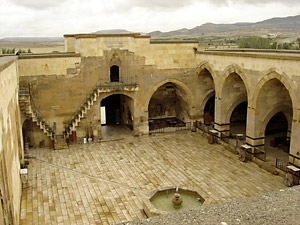
Caravanserais were high-walled (for security) and provided lodging for the travelers, food for pack animals, medical assistance, shoeing services for the animals, and secure rooms for locking up valuables. There was typically a central courtyard where socializing would occur, and there were often heated tandir ovens in the floor for heating the rooms of the travelers. The interiors were frequently elegantly tiled (https://www.goreme.com/caravanserais.php). https://www.academia.edu/7104413/_This_World_is_an_Inn_Cosmopolitanism_and_Caravan_Trade_in_Late_Medieval_Armenia
What an interesting combination, a trading center sometimes hosted by mystical brotherhoods, but also frequently hosting travelling monks and mystics along with the merchant traders (probably frequently these two roles co-existed in the same person), often built by the king, and hosting the exchange of goods, ideas, and culture. These islands of safety sponsored mercantile as well as cultural and religious exchange. These caravanserais, and the towns connected to them, were probably the places where cultures most interacted and got ideas from each other, the origin of a great deal of cultural syncretism.
These caravanserai towns were the source of a great deal of prosperity, and this prosperity grew from trade. This trade resulted in the exchange of ideas and culture and was sponsored by the kings and the religious orders of the area. And this trade connected people and cultures. These cultures did not become something besides themselves, however. The Chinese were still Chinese, Europeans still Europeans, and Persians still Persians, but this exchange led to what we call a Golden Age. This golden age ended after the writings of Al-Ghazali led to an aversion to intellectual thought and Islamic fundamentalism arose, sapping vitality from the intellectual and cultural culture of the region, and opening a door to Turkic and Mongol destruction and takeover. Europeans took it from there and did an end-run around central Asia with sea exploration and the development of colonialism.
We can think of these as romantic relics from the past, but they speak to us today for good reason. Post-post-modernity, the time we are living in now, is a strange time. Called Liquid Modernism by Zygmunt Bauman, the unique feature of our time is that in this time we are all nomads. Reality is liquid. Solidity is gone, permanence and stability are a thing of the past, and we are all now travelers engaging in gig work, piece work, and temporary contracts. Modern businesses are notoriously decentralized and connected only by internet links. A friend is running a quarter billion-dollar company from his apartment with three assistants in his spare bedroom and teams spread across the country. His company is a website and a network of connections, his product is information which enables business deals. Where is the solidity, the giant factory? My friend and I are working on our laptops at a café right now, but it is actual work (or maybe avoiding actual work at the moment in my case, but the pile of paperwork is tapping on my shoulder). Obviously, some of these factories still exist, but they don’t define the times, are not a leitmotif of the era. Our era is defined by uncertainty and nomadism- of a different kind than in the old days, of course. But we still need some places of safety and exchange in our nomadism. We are daily, endlessly, inundated with different cultural ideas and peoples, especially in cities where most of our work is today.
Are cafes and the internet our new caravanserais? I’m doing my nomad work surrounded by Afrocentric history paintings, listening to Ethiopian music, and reading central Asian history on my laptop. Is this really any different from the old traders on their physically nomadic journeys, talking to other traders from far away lands at the caravanserai. If you want stability and continuity this is not the world for you, but you can see people trying to achieve that dream nonetheless. Some are searching for a strongman to take control and bring everything back to normal, returning us to the past, to an understandable world. This won’t work, however, as the genie is not going back into the bottle. When reality is constantly shifting and we are all made into travelers we also need society to create some level of safety while still letting all the exchange occur- this is where public safety and social safety nets comes in. Trying to shut down all the change isn’t going to work, and the effort would probably just cause stagnation and a collapsed economy.
There is a solution, however, the same one the ancient travelers found. Exchange ideas, learn from the other, absorb their ideas and culture and make it your own, but put it in your own clothing. Use your own ancient texts and traditions, but reinterpret them to account for and be able to contain the innovations. Once you do that you are no longer surrounded by difference, only variations of appearance. This led to a golden age in central Asia, an age that was shut down when fundamentalism arose.
An example of how this can work is easily found, although in fact we are doing these things all the time. Christianity in the West is being pressured on all sides by the arrival of new religious ideas from other traditions, along with pressure from psychology and science. One solution that is popular today is the Christian Fundamentalist approach- shutting down to any changes and innovations (although, actually, it is an innovation of a sorts itself) and finding all Truth in a literal interpretation of the Bible. That worked for some churches for a while, but the younger generation is not going for it, and attendance at these churches is falling. A different approach is one that I think has greater long-term viability- in the spirit of adapt or perish. Some Christian teachers such as Thomas Merton, Father Thomas Keating, and Nicholas Roerty have responded to the interest in Eastern meditation by looking within ancient western Christian teachings, as well as investigating techniques preserved in Eastern and Orthodox Christianity that directly compete with foreign religious traditions, as well as satisfying some of the needs filled by psychology and self-help approaches, and have taught the use of the Jesus prayer and developed Christian contemplation as an approach for public practice.. This technique, long associated with Orthodox Christian Hesychasts, is spreading throughout western Christianity.
This is an example of modernity challenging a tradition and the tradition responding by adopting an innovation from another branch of its own tradition- Orthodox and Syriac Christianity. As would happen in a caravanserai where everybody is learning from each other and ‘trading ideas’, the tradition responded to competition by learning from others and updating their own tradition. Rather than retreating backwards the tradition adopted an innovation. This gives Christians who are interested in the meditation offerings in eastern religions a way to stay within their own tradition. Eastern meditation breathing techniques are adopted as ‘relaxation techniques.’ ‘The Way of A Pilgrim’ (an English book from the 1800s); ‘The Cloud of Unknowing’ (a Catholic meditation manual from the Middle Ages); and the writings of Pseudo-Dionysus the Areopagite (from classical times) have been revived in the West as well. In this way the challenge of foreign religious traditions has acted as a source of revival of the West’s own tradition, made it stronger, and made it better adopted to the present world’s demands for meditation as a tool for use by lay practitioners.
There are plenty of debates about how to manage such cultural interactions in the modern world. We are all familiar with debates about merits of multiculturalism- letting cultures within a country coexist without trying to convert everybody into following a single cultural pattern. A bigger debate in our times is about how we can all learn to coexist on our increasingly small world despite the differences between our cultures. Unlike in earlier times, but very much like the cultures along the silk road, we are unable to ignore different cultures- their people are our neighbors and friends. We may need to do business with these cultures on a regular basis, yet we have seemingly big disagreements about many things. This debate is being had under the name of ‘cosmopolitanism’. Cosmopolitanism was the spirit of the cities of the Silk Road- many cultures coexisting and learning from each other. “the ‘Silk Road’ has become globalization’s fashionable nostalgia, expressing a ‘longing’ (algia) for a cosmopolitan ‘home’ (nostos)” https://www.degruyter.com/downloadpdf/j/culture.2017.1.issue-1/culture-2017-0019/culture-2017-0019.pdf. Clearly, others have noticed the connection between the ancient silk road and modern cosmopolitanism. It’s an interesting and complicated subject and worth thinking about. Here’s a little discussion on this subject: https://www.dartmouth.edu/~themalsjournal/pdf/winter14/badger.pdf. In fact, the era of the ancient silk road has been referred to as the era of ‘classical cosmopolitanism’. So what can we learn from those times that we can apply to today? Probably a lot. The experiment has already been performed, successfully, on a smaller scale and there’s no reason the process can’t be scaled to global scale.
Of course, the same enemies of global cosmopolitanism are still present. It was destroyed by fundamentalist religion and marauding Mongols in the past, and similar things could happen again. Perhaps a reversal of cosmopolitanism and globalization could be caused by people’s reactions to the changes that globalization is bringing, and concerns about the possibility of the very real issue of mass migration triggered by climate change. However, there still remains no good reason in these issues for us not to nurture a cosmopolitan spirt while political, scientific, and legal solutions are found for these very real problems.
Some variations of cosmopolitanism have been examined and are rightly thought about. We can think of cosmopolitanism as being along a spectrum. On one end we have nationalism and fundamentalism, a view that is closed to learning from others and in which one keeps to one’s own traditions purely. On the other end we have a person who is wide open to everyone else’s traditions and is concerned with everybody and every being in the world, not giving any preference to one’s own home community. Both extremes can be very problematic in very real ways. The former is likely to result in conflict with others and to be resistant to change and adaptation to new conditions. The latter causes a neglect of one’s own local responsibilities and local culture, building no connection to the local community and those who are likely to be directly connected to that person or community, making one a target of one’s own people. A better solution is articulated by Kwame Anthony Appiah, who argues for a moderate cosmopolitanism where we maintain an openness to others and a ‘cosmopolitan curiosity’ while at the same time engaging fully with our local culture. We can call it a ‘partial cosmopolitanism’ wherein we can recognize the universality of values and the equal validity of other ways of being while at the same time embracing our own home culture. https://www.globalethicsnetwork.org/profiles/blogs/cosmopolitanism-pluralism-dialogue-and-global-citizenry-for-a-new
Caravanserais remain as a physical reminder of a spirit embodied in Central Asia, since ancient times, of a way of cooperating and learning across the boundaries of civilizations. There was government and religious support for exchange and trade. Syncretism was a fact of life (although even central Asia eventually developed its own Islamic fundamentalists, heralding a cultural decline and the end of the Islamic Golden Age). The spirit of cosmopolitanism drives progress and cooperation in all spheres of life and should be cultivated.


As an art historian researching the visual evidence of trade along the maritime Silk Route and with the Far East prior to 1500, I would welcome a conversation. I hope you can see my email address in your comments box and look forward to hearing from you.
LikeLike
Sure- about what? I’m no art historian but I certainly do find the subject interesting
LikeLike